A Culture of Violence
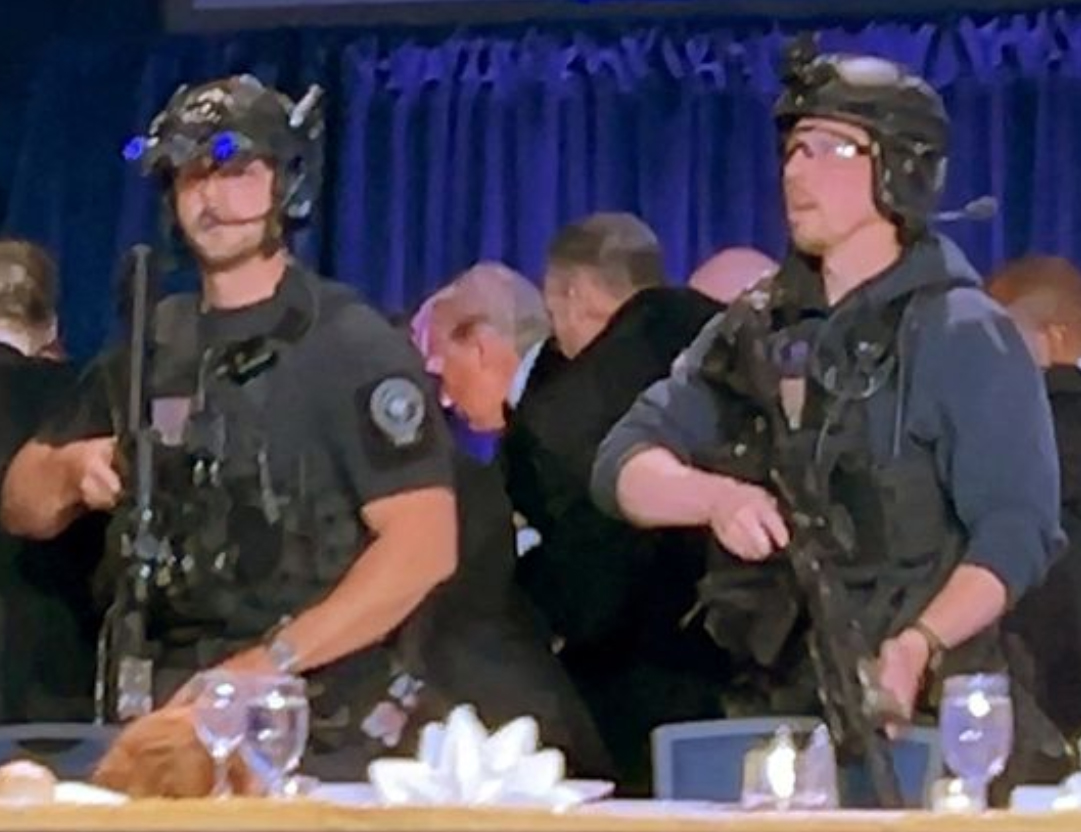
(photo credit: screenshot of President Trump being rushed from the Hilton Ballroom)
Political violence must have no place in American life. None. Period. And yet, the violence keeps happening.
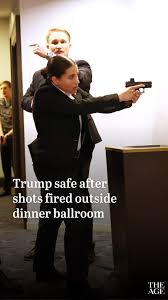
Last night’s shooting at the White House Correspondents Association dinner at the Washington Hilton was another terrible reminder of the dangers we all face — dangers to human persons, yes, but also dangers to our increasingly fragile Democracy. We can and should be grateful that the shooter was quickly apprehended and that no person was killed; we can and should be grateful that, no matter our political differences, the president, vice president and cabinet officers escaped unharmed. We can and should be grateful to the Secret Service officers, police and National Guard troops who responded quickly.
But condemnations of violence and expressions of gratitude for the safety of public officials are not enough. We can and we must recognize the obvious fact that the political tension in this country is well past the boiling point, and that some individuals will take whatever opportunity appears in their imaginations to commit horrific acts of violence. We can and must recognize the fact that our culture has become extremely violent, not only in acts but also in our communication styles, in the accusations and insults that fly so freely on social media, in the deep sense of aggrievement that some people harbor and use as an excuse to lash out.
We have lost the ability to disagree civilly. I disagree with the current president about many issues and his behaviors, but I do not wish him any harm; I just wish he would tone it down and be kinder to those who have different points of view. But in America today, we seem unable to have a rational argument about principles at stake in policies and governing actions. We are living in a zero-sum game in which every opinion that does not align perfectly with the opinion of another invites a brutal, violent, sometimes fatal response.
We live in a very strange era in which the president of this nation, himself, uses violent and profane language in his social media communications and speeches — and some cabinet officials as well — and this verbal violence encourages others. We need our public leaders to grow up and demonstrate a greater awareness of their responsibility to set the tone for our society, a tone that should always communicate respect for others even in disagreement about ideas. Every public figure — elected and appointed leaders, teachers and school leaders, sports stars, movie heroes, music legends — every single one of us must do a better job of showing others how to engage vigorous debate without violent imagery or degraded language.
I’m old enough to remember a time when shots that rang out against public figures were actually shocking — the assassinations in the 1960’s of President Kennedy, Dr. Martin Luther King, Jr., Robert Kennedy. The attempted assassinations of President Reagan and Pope John Paul II within two months of each other in 1981 stunned the world. Now, in 2026, when shots ring out against public figures we hear arguments about whether the event is fake (ridiculous!), whether we can control guns (yes, we should!), whether they had it coming anyway (never!), whether the “other side” fomented the violence (responsibility for the tone of the culture is a burden we all must share). We hear little consensus on the most fundamental issue of the deep and protracted violence of our culture — and how to remedy that profound danger to the health of our society.
On his recent 11-day 10,000 mile tour of African nations, Pope Leo XIV spoke often of peace, at one point referring to himself as a “pilgrim for peace.” Perhaps it is emblematic of our times that even a pope speaking about peace — a fairly routine message for most pontiffs — drew extreme blowback from some commentators. As I read some of the more belligerent rejections of the Pope’s message, including from some Catholic politicians, I found myself wondering how we can ever reach a place in our culture in which we can agree to disagree without wanting to destroy the other person.
Pope Leo offers us hope that at least one powerful leader has the courage to show a pathway to a different future, one that offers peace and hope rather than constant war and violence. We can also hope that the people who feel most at risk of ongoing political violence — current political leaders — might see in the Pope’s careful words and of soft-spoken courage a model for their own public pronouncements.
To change this violent culture, we must work harder to foment peace.
Read the statement of USCCB President Archbishop Paul Coakley on the WHCA incident
