
Artificial Intelligence: Student Perspectives, Part II
Join me for a session of Campus Conversations on the topic of Artificial Intelligence at Trinity on Thursday, November 19 at 4 pm on zoom…. link coming on email….
My last blog providing the data from our student survey on AI ended with the data for Q15 (presented again, below) that asked students to indicate their concerns about Artificial Intelligence across a range of statements. 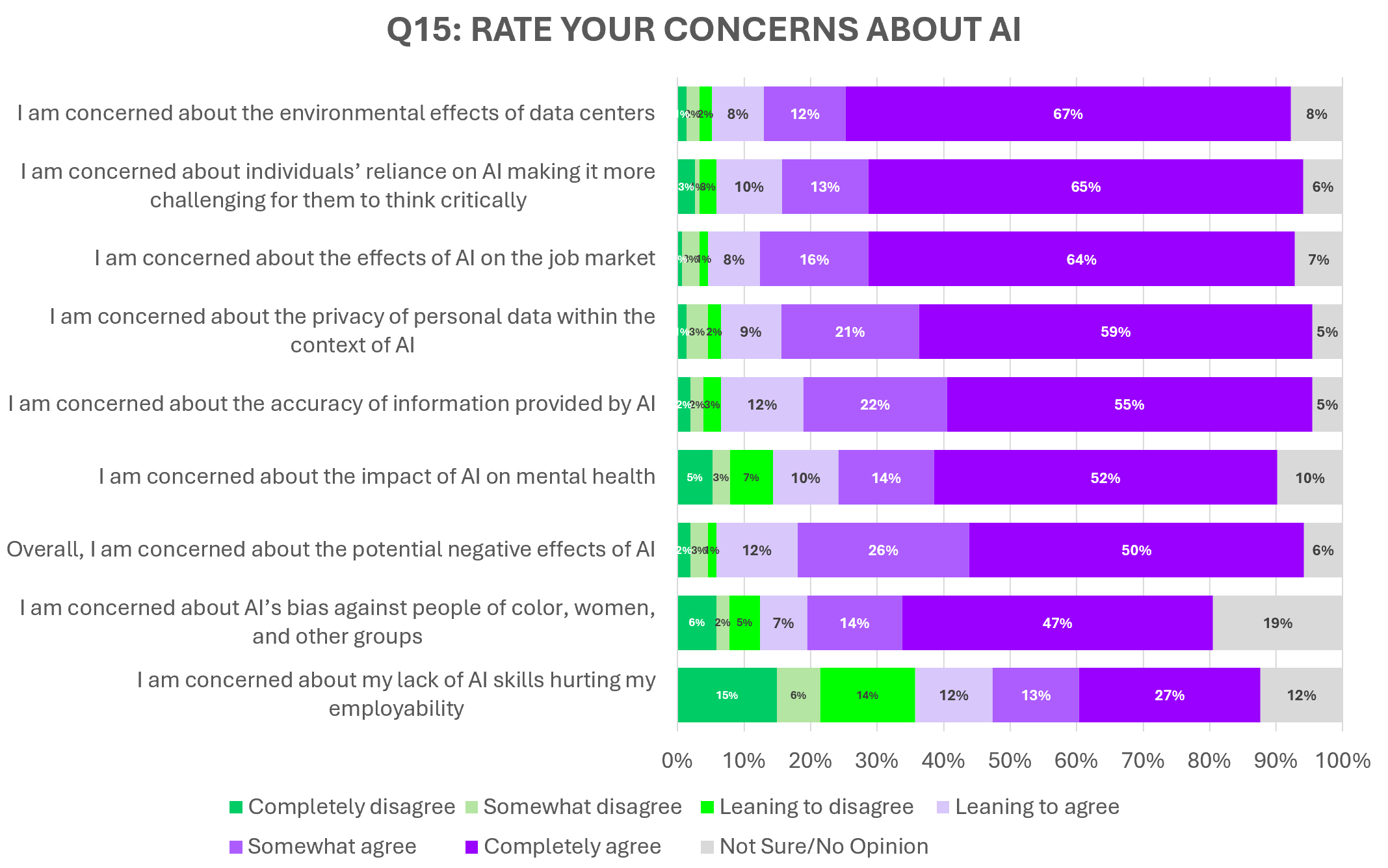
This blog is starting with the student comments on that question since they are so revealing about student dispositions toward AI today:
CAS students had many concerns:
- Privacy…I’m not really confident that my chats with AI are private.
- I’m just a little worried because now a days people are studying to be doctors and lawyers but then be using AI so how can we as citizens feel comfortable putting our lives in their hands when they rely on AI for the answer instead of having their own knowledge.
- I am worried about how it is brain rotting Gen Alpha, Gen Z, and Millennials.
- In the future, what will happen to many people whose jobs are taking by AI. Why do many rich men believe AI will do a better job then a person with feelings and care.
- Data Centers are harmful to the environment and the people around it. Using AI rejects the development of a better society.
- The biggest concern I may have is that students might become too dependent on AI instead of developing their own critical thinking skills.
- AI has no original information and I am concerned about where it gets its information. Additionally, I am concerned on how the accuracy of the information given can personally affected various communities including women, people of color, children and immigrants.
- I don’t use it at all because of the many horrible consequences that AI has brought upon humanity. Our clean drinking water, electricity used for our homes, land that families have been removed from for the sake of AI data centers, and hundreds of human-driven jobs are being taken from us in exchange for things we could already do. Creating art, photos, and videos is not impossible without AI. Sending an email, text message, audio response does not require AI.
NHP students also expressed many concerns:
- I don’t like what data centers specifically are doing to the environment and minority communities.
- AI actively harms Black, brown, indigenous, marginalized communities and should not be used for everyday life, unregulated, “for fun”, like it currently is. I am making an informed personal decision not to use AI, as someone with an understanding of how it works, having attended trainings, having used it before, and all evidence supports me NOT using AI if given a choice. The use of AI and AI infrastructure are actively destroying our climate, environment, and communities, at the expense of human lives and well-being. I believe those who use AI, who have been educated to “know better”, when given the power, agency, and choice to NOT use AI, are complicit in this harm.
- I have concerns that I don’t know enough about AI’s impact on the environment as well as any bias against people of color.
- I’ve noticed that folks who use AI a lot seem to lack critical thinking skills.
- For school: If I don’t understand a question or topic I ask ChatGPT to break it down for me and I often have conversations with it as if I were talking to an actual professor so I can explain in my own words and it can tell me if I explained it well and if I understood. It’s easier because I’ve had too many experiences where professors get frustrated with me for not understanding at their pace or level when I need someone to be more slow and patient with me.
- When writing I use AI to clean up grammar and ensure writing is in APA format by checking my work.
- Study guide or assistant, especially for math practice problems and suggestions for writing essays.
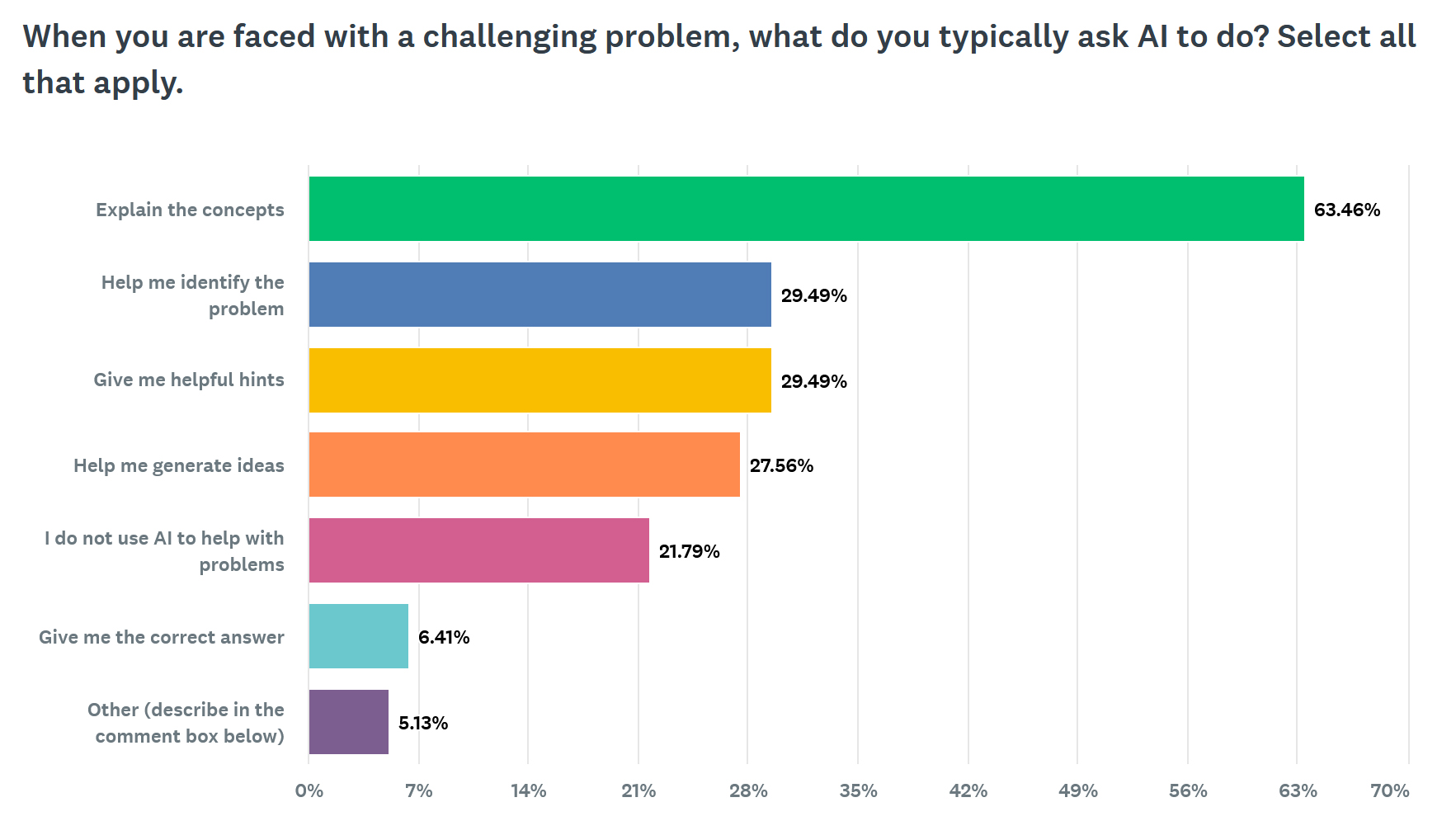
Student comments — many students use AI to help them study, conceptualize problems and solutions, work out challenging issues..
- I tell them the problem and ask for help. And if I am still struggling in conceptualizing/solving the issue I ask for explanations as to why the issue is occurring or what I can do to fix it
- Help me align my assignment with the rubric expectations
- Create visual aids to understand concepts, test my comprehension
- When I use it now, for example, when I’m having difficulty balancing an equation and continue to get the wrong answer, I’ll give AI the question, tell it the answer I’m getting, how I’m getting it, and why I’m doing it the way I am. Then I ask it to help me reason it out rather than just giving me the answer. Sometimes, when I’m trying to reason it out for AI, I will figure it out myself
Q11 asked the respondents to elaborate on why they use AI for academic as well as personal purposes. The answers are very revealing:
- AI helps me to more understand certain concepts I may have not fully understood in class.
- Academically: I use it sometimes to explain certain academic concepts when im having trouble understanding. Personally: For my job outside of work I use a lot of Microsoft platforms and I use it to help me learn certain features
- I use AI to explain concepts I have issues understanding. When I have asked for help from professors they end up losing their patience because they get frustrated with me for not understanding. Sometimes I feel embarrassed to keep asking the tutors to breakdown even more their already broken down explanations so AI helps me when they’re not around like when I’m at home or when I simply don’t understand and need someone to help me without losing their patience and throwing a fit because it has happened before from professors
- I use it for comprehension when I’m overwhelmed and to organize my thoughts
- I use it to help with study guides and exam notes.
- I would only use AI to check grammar, to study, and to explain something I don’t fully understand. As in if my teacher worded a question weirdly I would ask AI to state it in a different why or explain what the question is asking
- I use Grammarly to check grammar and spelling in my writing. I use Microsoft Copilot to check my emails. I use Google Gemini to check my math problems. I take a picture of my work, and it tells me what I did right or wrong. I use ChatGPT to make study guides for exams and to make practice exams.
- I don’t use it to complete my homework or course assignments cause my academic integrity is one of the most important things in my academic career. However, it has been very helpful in explaining the in-between steps; sometimes it tells me the same thing over and over again until I get the concept, which is something that your teachers can’t do. I’ve been a student since before using AI was popular, so I think I manage my AI use effectively.
- I do not think anyone should be using generative AI especially in an academic setting
- I use AI when I am overwhelmed, can’t think of any other solutions or just don’t feel like thinking
- I’m an event planner. AI is everything. I’m also a teacher, my kids use it daily
- I am in school entirely because I want to learn, there is no benefit is using AI to cheat. It provides so many additional modes of learning than what can be provided. It has created dozens of examples to help me understand concepts and real world and has helped me identify my areas of weakness
- I learned that ultimately, by leaning on AI, I was becoming dumber, less connected to the people around me, and feeding my data to and getting information from companies that I don’t fully trust or support.
Q12 asked how AI has influenced student approach to academic work. A number of comments were like these:
- It’s like a helper that is always available. So If I stay up all night to study an do assignments and I have question I don’t have to wait until the next day to ask my professor to understand certain things.
- It influences me to approach my academic work in small steps. Taking my brain back to the basics, coming all the way up. Almost like a shock of knowledge.
- AI has helped me understand assignments better. It helps me get started on assignments when I’m having a mental block and don’t know where to start.
- AI does sometimes make me feel confident in my academic work when I don’t understand something. I use it as an additional learning resource, not to replace my own thinking.
- It has influenced me to not always rely on it but, it has been a way for me to get help right away at the moment instead of setting up appointments for tutoring.
- It has made me more confident academically, especially grammatically. Because I’m able to see, learn and understand my mistakes to better myself.
- I now break down tasks into smaller items and do them in phases which makes it easier to tackle rather than being overwhelmed by the assignment as a whole.
- I think it makes me more nervous that I could be accused of cheating or plagiarism. I have a friend who didn’t use AI, but she was accused of doing so.
- It has only made me more paranoid that my work would get flagged as AI because I know how to do my work efficiently
- If anything the normalization of AI use has encouraged me to stay away from it and rely on myself for assignments. However, now it feels like when writing an assignment, I have to include mistakes to further prove that I wrote it rather than AI generated work. This has caused some frustration with many of my classmates as well.
- In practice, I have made essays simpler and stopped using the em-dash and stuff out of fear that professors may think I used AI. One of my biggest fears is getting accused of using AI when I legitimately did the work. Personally, it has certainly made me harder-headed in terms of trying to figure out the answers for myself. Like I said, I really do not like the idea of rich, right-wing freaks (ex: Peter Thiel, Sam Altman, Elon Musk, etc) making billions off getting all of us to disconnect from each other and stop thinking for ourselves— so I’m def trying to get smarter out of spite for them.
- With AI becoming more popular it’s harder to work with people who are so reliant on it. Their work is inhuman and never makes the work seem meaningful. AI being so popular makes me want to become a better student to combat it.
Q17 and Q18 asked students to comment on faculty use of AI, and they did not hold back. Nearly 90% of students say that faculty DO use AI for instructional purposes. Some of those purposes include:

Some of the student comments on faculty use of AI:
- I think instructors should be able to use AI in their class material but also be held to the same standards we as students are being held to. For example, if students aren’t allowed to use AI at all, instructors should be held to the same standard.
- AI actively harms our student body, our community, and our environment. It is not socially just not ethical to use AI while purporting to support our students.
- I think that if we can’t use AI for academic purposes neither should faculty and professors!!! I think it is extremely frustrating to have to read AI generated curriculum and I never understand my assignments when they use AI.
- If I knew a teacher was using AI to generate any work (I have one teacher that I suspect uses AI for slides), I would be really concerned. Not only about the legitimacy of the content I’m paying to learn and their mastery of the topic, but also about their professional judgement.
- It’s disheartening to even believe that professors are using AI for their assignments. Why even pay my tuition if AI is going to be teaching me? Why even go to college if I’m not paying for the expertise of a professor? It’s ridiculous. I expect their work to be just as authentic as mine.
- Simply telling students they cannot use AI will not stop them from using it. Many will still use it and claim they did not. Instead, educators should use real-life examples to help students understand that AI is a tool that can support their work, but it cannot replace the foundational knowledge and skills they need to develop for their chosen careers. I also think colleges will need to adapt how they teach and assess students. Written papers and computer-based exams can make it too easy to rely on AI without demonstrating actual understanding. Although this creates more work for professors, I believe they will need to develop assessments and projects that require students to demonstrate critical thinking and apply what they have learned.
- I think it is a useful tool. It is also where technology and our society are headed. Turning our backs on it or making it the bad guy will not stop it from becoming part of everyday life and tasks.
- I think colleges should start teaching students how to use AI responsibly instead of simply discouraging it.
- We should all do research on the harmful effects that the AI “boom” has had on the world, as there are many of them. In a vacuum, AI is deeply interesting and has great potential; but the countless negatives brought by the current reality of AI cannot be ignored, and until these issues are resolved, I cannot, in good conscience, use AI, and must oppose the use of AI in any feasible way I can.
- I would like Trinity to create a course, an elective of sorts, that students can take to learn more about all the different aspects of AI
- I know AI is the “new, exciting tool” but as a scholarly institution we should strive for the betterment of all students and finding “shortcuts” undermines the whole process of learning. There is no ethical way of teaching people how to use AI because AI itself is not ethical.
Where do we go from here?
All of the input from this student survey is now under discussion among the various work groups of the Task Force, and we will be meeting again in December for updated reports from the work groups.
Meanwhile, we want to find the best way to keep students fully engaged with this project. I hope that students who are interested will join us for Campus Conversations on November 19 at 4 pm on zoom when we will continue this discussion and welcome more ideas.
Thanks to all of the 158 students who participated in the survey!
