Educated Women Can Change the World
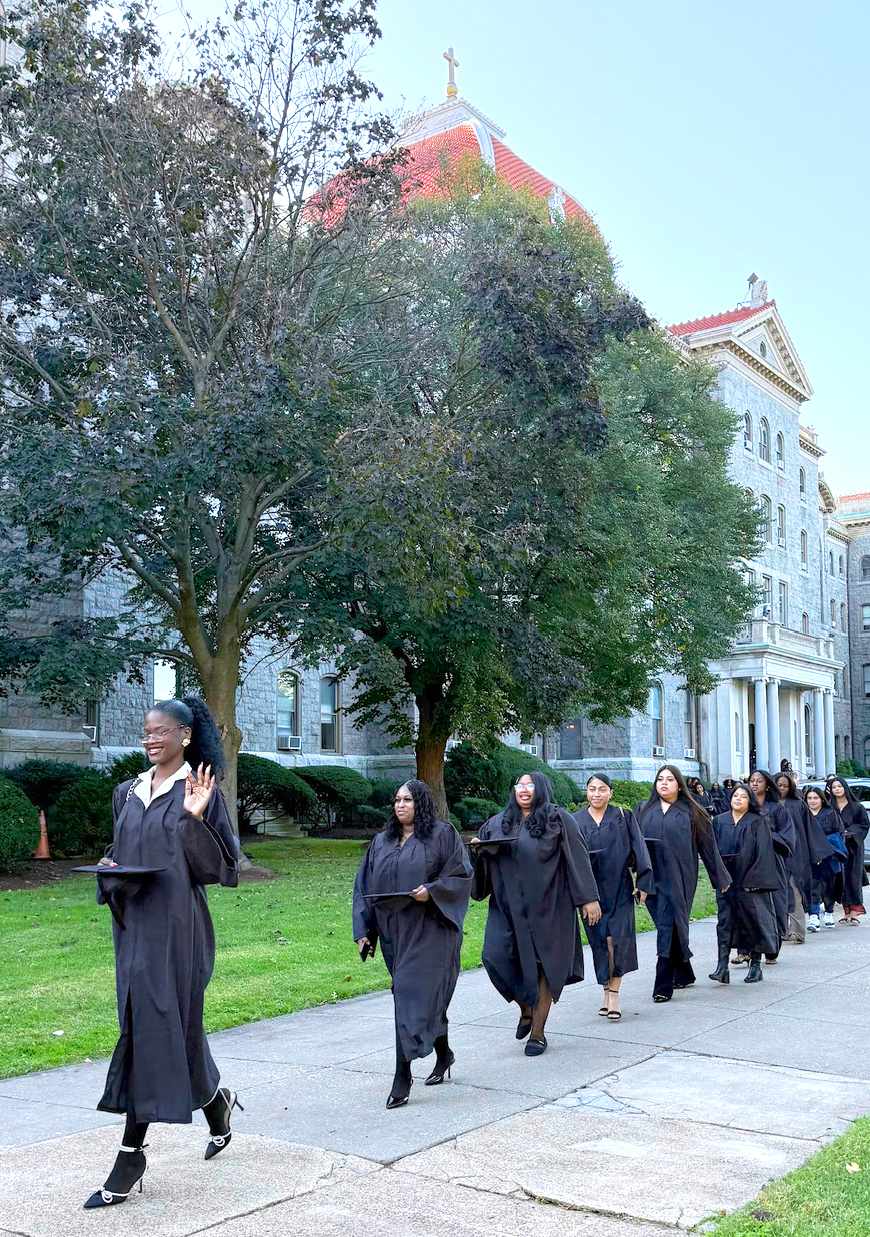
(Student Government President Millie Okoro ’27 leads the senior procession for the Cap and Gown Convocation on Saturday, October 24, 2026, photo by Timothy Russell)
Educated Women Can Change the World
Remarks for Cap & Gown Convocation 2026
President Patricia McGuire
Earlier this semester, our award-winning Trinity Times published several important stories that lift up the voices of Trinity students in important ways.
In one recent story, three students with Nigerian roots talked about the importance of education for women. Millions of young girls in Nigeria do not have access to education, and the impact on their families and economic circumstances is devastating. Like all of our students, our Trinity students with Nigerian heritage are here to change their own lives and those of their families and communities.
Princess Garuba, a sophomore on her way to a Nursing career, says that, “Education can … help break the cycles of poverty. When women earn more income, families have better access to housing and food. Better nutrition leads to better long-term health.”
Millie Okoro, a senior and our student government president, reflected in this way: “Educating girls has a ripple effect across economic and social development. When girls are educated, workforce participation increases, which boosts economic growth. Child marriage and maternal mortality rates tend to decrease. Families invest more in health, nutrition, and future education. Education also shifts cultural expectations and it gives girls agency, decision-making power, and long-term stability.”
Esther Joseph, a junior biology major, sees it this way: “…girls’ education has a major impact on national development because it affects health, economic growth, and social stability all at once. When girls are educated, communities see lower poverty, better healthcare outcomes, and stronger leadership. It’s one of the most powerful tools for long-term national progress.”
If you listen carefully, you can hear the cheers of our Trinity Founders, Sisters Julia McGroarty and Mary Euphrasia Taylor, echoing across 12 decades of women’s education at Trinity. The words of our students today are infused with the wisdom of the courageous women who, in 1897, saw that women in this country, in this city, did not have equal access to a great higher education and so they decided to do something about it. They knew that educated women could change the world. They set about the very hard task of founding the nation’s first Catholic college for women; they faced considerable opposition from men who said that women should not go to college, that college would impair women’s health, maybe impair their childbearing ability, maybe make them ambitious beyond being good wives and mothers, which is certainly a sacred calling for most women, but not all that we women can do.
Know what? Some men are still saying things like that in some of the highest offices and darkest corners of our nation; some men are still enshrining that misogynist attitude toward women in the policies of some nations around the world, as our students of Nigerian heritage and other nations know too well.
Some men and politicians are saying and doing things today that make it clear that exclusion from educational opportunity is still a real problem in this country. There’s a war against programs that lift up persons who have been historically marginalized in higher education on the basis of race, gender, nationality and other characteristics. The political misuse of civil rights laws to roll back diversity, equity and inclusion initiatives is limiting opportunities for Black and Brown students across the nation. Right now, the current political administration has sued every state in the country that welcomes undocumented students into public universities at in-state tuition rates, including UDC. This cruel campaign is robbing highly talented students of educational opportunities that would benefit not only the students and their families, but their communities and our nation.
As a private Catholic university, Trinity welcomes and supports many undocumented students in partnership with organizations like TheDream.US; we cherish the large diversity that our immigrant community brings to our campus. Yet, as another recent Trinity Times story recounted when considering the anti-immigrant rhetoric of our current president, we know that our immigrant students often feel at risk because of the political climate in this country right now. Our commitment to you is to make sure you get the best education, to provide the support you need to thrive here, and to work with friends and allies in advocacy to do our best to keep pathways for your progress open. Our Trinity Founders would expect no less of us.
We are in a moment in this nation’s history, as we celebrate the 250th birthday of the American Experiment, in which the rights and freedoms and achievements of the last century’s quest for simple justice are at grave risk. This is a moment to reflect on why Trinity was founded, and why we persist in this day and age as a university that still emphasizes women’s education and leadership, why we are proud of our evolution as a center of learning that welcomes so many different races, ethnicities, religions and experiences to this small but mighty campus; why we continue to emphasize the foundation of our mission in Catholic teachings on social justice.
Make no mistake about it: there’s a great movement underway to roll back the clock on the American experience, to re-set this nation’s culture to a time before equal opportunity for all, a time before civil rights, women’s rights, LGBTQ rights and justice for all. The political movement to abolish educational and corporate programs that promote diversity, equity and inclusion are thinly veiled efforts to return to times we thought were long gone — times in which many if not most of the people gathered in this room today would not be welcome in the academic, social, cultural and leadership rooms of America.
And for those who think that this country no longer needs DEI programs, you need look no further than the University of Maryland where, last week, the club tennis team used Ku Klux Klan imagery on a flyer about a tennis tournament. The KKK is the ultimate symbol of the era of white supremacy, racial hatred and violence against African Americans. The fact that some students at one of the nation’s leading public universities think that a KKK image is funny or in any way appropriate speaks to the urgent need for ongoing education for racial reconciliation and healing in this country. But, instead, the current political administration has threatened all universities with penalties up to and including stripping tax exempt status if the institutions promote diversity, equity and inclusion.
Trinity WILL NOT BE INTIMIDATED by these political threats!
Trinity was founded because women were excluded and demanded inclusion. Historically, the first several generations were white Catholic women reflecting those times. In the late 20th Century, the Sisters of Notre Dame challenged Trinity to open her arms wider and expand her reach for inclusion to a far broader population of women including women who bore the great burdens of racism, economic and social marginalization in the capital of the free world.
Trinity today is proud to be one of the most inclusive universities in the nation, one of just two private institutions designated as both a predominantly Black and Hispanic serving institution. This is a university devoted to principles of equity and inclusion from our founding moment, and we cannot deny nor will we change those values. We have expressed those values in our policy known as Trinity DARE – Driving Actions for Racial Equity. And we will continue to stand for equity, inclusion and justice for our students and all whom we serve.
Our commitment to these values is enshrined in the religious freedom we have as a Catholic college devoted to the Church’s teachings on social justice, the foundation of our mission and of a good society.
Today, our seniors, the Gold Class of 2027, join a long line of Trinity students and graduates who have worn these academic robes with pride and courage. Your caps and gowns symbolize your full entrance into the community of scholars whose lifelong ambitions are not simply to use your knowledge and talents in service to your own needs and interests, but, truly, to change our world for the better thanks to your passionate commitments to equity and justice for all. Wear your regalia as sacred vestments in the high church of moral action for the common good, cloaking you in the privilege of an education that the majority of people on this planet will never enjoy. Your privilege imposes an equal responsibility to use this gift of learning in service to others, to raise your voices when others cannot speak, to blaze trails across unfamiliar terrains, to insist on the truth of the ancient phrase that “…justice will not come until those who are not hurt are just as outraged as those who are.”
As you march from this Chapel today, may you wear your caps and gowns with pride, and go with the power, wisdom and love of the Trinity as your constant companion and source of inspiration through all the days of your lives.
Congratulations, seniors!
2 Comments

What would you say to seniors that are republicans? Also you realize that educated women include kellyanne conway nikki haley and muchelle bachman
Congratulations, Trinity!!