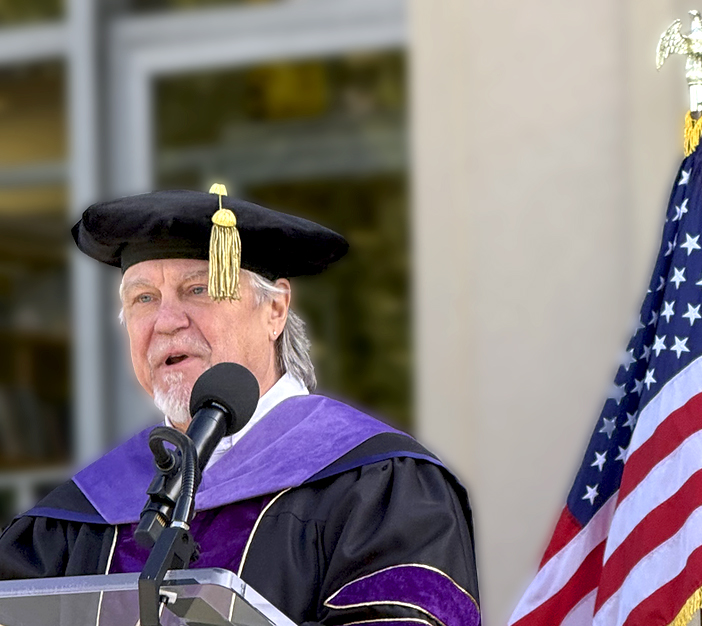
Dean Mostowy on Voting Rights: The Battle Never Ends
Dean Thomas Mostowy, Dean of the School of Professional and Graduate Studies,
and Professor of Criminal Justice, offered these remarks at Trinity’s May 2026 Commencement:
Congratulations to the graduates and a special welcome to all the family and friends who supported them. We know that each of you has contributed to this day in your own way and that no one really achieves success alone. It’s a community effort.
Every year, when I sit down to prepare a graduation speech, I try to find a quote that I think is relevant, inspirational, or at least somewhat humorous to build my remarks around.
Last winter, for example, I chose James Baldwin and his thoughts on why education for working-class people is so important to a democratic society and, thus, why it is so frightening to those in power.
After watching some recent developments in government policies regarding higher education, I was severely tempted to return to that subject. Unfortunately, I was “saved’ from repetition by the US Supreme Court’s decision last month in Louisiana v. Callais .
So here’s a quote for you:
“The right of citizens of the United States to vote shall not be denied or abridged by the United States or by any State on account of race, color, or previous condition of servitude.”
You don’t have to be a Constitutional scholar, or even a lawyer, to recognize section 1 of the 15th Amendment. Oh, and just to be sure not to leave anyone out, let’s not forget this one:
“The right of citizens of the United States to vote shall not be denied or abridged by the United States or by any State on account of sex.”
Yes, It took another 50 years after the 15th Amendment was ratified before women were extended the same right via the 19th Amendment.
Now, as I often point out in my criminal justice classes, possessing certain unalienable rights is a fine thing, until someone in power decides to take them away. Then what? The problem with the Constitution is that it sets out the rules, but doesn’t say what happens if someone decides to break them.
That’s why section 2 of both Amendments said he same thing:
The Congress shall have power to enforce this article by appropriate legislation.
No problem, right? Enabling legislation to enforce voting rights should be pretty simple for such a clear mandate?
Perhaps not. For the next century after the 15th amendment was ratified, the South enacted poll taxes, literacy tests, white primaries, disenfranchisement laws and when all else failed, outright violence and intimidation. What we refer to as “Jim Crow” but was merely a way to preserves slavery by another name.
It took nearly a century after the Civil War for America to finally keep the promises it made in the 13th, 14th and 15th Amendments, with the Civil Rights Act of 1964 and the Voting Rights Act of 1965.
Regarding the passage of these laws, finally putting some teeth into the Civil War Amendments, President Lyndon Johnson said:
“In our system the first and most vital of all our rights is the right to vote. Jefferson described it as ‘the ark of our safety.’ It is from the exercise of this right that all our other rights flow”.
and
“[T]he vote is the most powerful instrument ever devised by man for breaking down injustice and destroying the terrible walls which imprison men because they are different from other men”.
But privately, according to journalist Bill Moyers, he also lamented: “We have lost the South for a generation”.
If anything, Johnson underestimated the strength of anti-democratic forces in America.
While it took the nation nearly two centuries to finally recognize the fundamental rights of all its citizens, The Supreme Court decided, just 45 years later in 2010, that all the work to repair those injustices was now complete. In Shelby County v. Holder, John Roberts said that “the country has changed, and… Congress must ensure that the legislation it passes to remedy that problem speaks to current conditions” as he cut one leg supporting the 15th Amendment off at the knee. Apparently over 3 centuries of legal discrimination had been remedied in just 45 years.
Finally, last month in Callais, Sam Alito chopped off the other leg in deciding that the Voting Rights Act’s purpose has been served, stating, “vast social change has occurred throughout the country and particularly in the South.” He even claimed, without any sense of irony, that prioritizing electoral map-making to boost minority political power somehow violates constitutional prohibitions against racial discrimination.
So where does this leave you? Newly minted graduates and future leaders of your communities. It means your education will provide opportunity to flourish in your careers, but I hope it also instills a sense of responsibility. My generation mistakenly thought the battles for democracy and equality had been won, but the battle never truly ends because those in power will always fight to maintain their inherited privilege. It’s now your time. Yes! Use your education to do well for yourself and your family, but remember it is also intended as a tool for good in you community, your society and the world. All politics is local and your community needs you.
Congratulations and best wishes!
