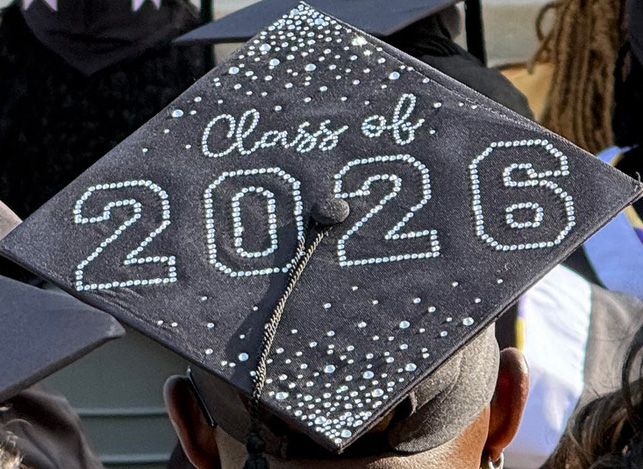
America300 and the Legacy of the Class of 2026

(Photo credit: Timothy Russell)
Envisioning America300: The Legacy of the Class of 2026
President Patricia McGuire
Remarks for the 123rd Trinity Commencement
May 15 and 16, 2026
To Trinity’s Class of 2026: your graduation from Trinity this year coincides with the 250th Anniversary of the Declaration of Independence on July 4, 1776, a date revered as the birthday of the United States. We will spend some time this summer enjoying many festivities — marching bands, fireworks, field trips to historic sites or watching Ken Burns on the American Revolution — or even, I hear, viewing some kind of professional fight on the White House lawn. What could be more American?
But if all we do at this important chalkstripe across history is remember the past and nosh on hot dogs, we will have wasted both time and opportunity to do something far more important. Instead of looking back through a romantic haze of mythology about our nation’s founding, let’s look ahead with a fierce determination to make sure that these 250 years spent in earnest pursuit of the great American Dream do not vanish in a cataclysm of lost hope and authoritarian impulse.
You, the Class of 2026, will be celebrating your 50th reunion at Trinity in the Year 2076. (That seems impossibly distant right now, but having just celebrated my own 50th reunion, believe me, time flies!) 2076 will also be the 300th Birthday of the United States — our national Tricentennial. So, it seems reasonable to ask in 2026, as we celebrate America250: what will your legacy be to ensure that our nation will be strong, united and still free at its 300th birthday?
How will your Trinity education contribute to that legacy?
You have earned your degrees in many major fields — nursing, occupational therapy, counseling, teaching, science, journalism, business, criminal justice, law, global affairs, nonprofit advocacy, to name a few. But while your specific knowledge and skills may vary, if Trinity has done her job well you should have a strong set of shared values and philosophies that will guide your future work as citizen leaders and stewards of families and communities. What are those shared values?
Our banners and logos proclaim Trinity’s commitment: Education for Justice. Working for justice is our foundational value, received from our founders, the Sisters of Notre Dame de Namur, arising from the Catholic teachings on social justice and shared by most faith traditions. What does justice mean in this context? It means respect for the dignity and worth of every single human life, lifting up each person regardless of race or gender or disability or immigration status or who they love or what language they speak or the size of their bank accounts.
Justice is the value that fueled the passion of the Founders of this nation when they proclaimed “self-evident truths” in the Declaration of Independence, with God-given equality being the first of the “unalienable rights” including “…life, liberty and the pursuit of happiness.” The later preamble to the Constitution enumerates one of the purposes of government “to Establish Justice.” We speak of justice every time we pledge allegiance to the flag — “with liberty and justice for all.” “Equal Justice Under Law” is carved into the stone over the entrance to the Supreme Court.
Justice is the bedrock value on which our freedoms flourish. But today, the threats to justice are everywhere. The Supreme Court has diminished the Voting Rights Act of 1965. The Civil Rights Act of 1964 is being warped and twisted to protect the very interests it was enacted to oppose, undermining the rights of the people it was designed to protect. Officials at both the federal and state levels are rolling back the gains of prior eras, forbidding schools from teaching about diversity and inclusion that are manifestations of justice; banning books about racial and gender justice, scrutinizing the syllabi of college professors to find out if they are teaching “divisive concepts” like the role of slavery in the colonial economy; threatening employers and institutions that uphold ideals of equity and justice not only for Black and Latino and Asian persons but also for women and immigrants and LGBTQ persons and others who do not fit the notion of what’s acceptable to the prevailing power structure.
Government officials have imposed steep penalties on universities that once were champions of free speech and equal opportunity — no more, as school after school bows to federal pressure to step back from principles of justice and equity. The government is investigating colleges for enrolling too many Black students. (Just this past week, the Department of Justice opened an investigation into Yale Medical School claiming they favor Black students over others — just 44 Black students are at Yale Medical out of 553 total students.) Recently opening an investigation into Smith College, seems that the Department of Education now wants to tell women’s colleges who we may enroll and teach.
We women’s colleges and minority serving institutions are not reflecting pools to be painted over at the whim of the executive! We reflect our own shimmering commitments to mission rooted in social justice; our values are not subject to governmental edicts!
It took nearly 90 years from the nation’s founding in 1776 to abolish slavery with the Emancipation Proclamation and the end of the Civil War. But Reconstruction did not guarantee equality. It took another 100 years of bitter struggles, sometimes violent confrontations, constant advocacy and courageous action for this nation to enshrine equal justice under law into federal and state laws on equal opportunity, civil rights, voting rights, women’s rights. It took another half century for the impact of those laws to emerge in more level playing fields for people who once suffered historic racial oppression and gender discrimination. But today, in 2026, it’s taken just two years for the hard-won gains of the last two centuries of the American struggle for equal justice to be shattered.
It may take the next 50 years to repair the damage that’s been done — there’s no time to lose!
250 years ago, the Founders debated and rejected the idea of monarchy for their new nation. We hear echoes of that debate as we grapple with the now-contemporary question of how this nation will move away from the precipice of authoritarian rule. Our government is profoundly out of balance right now — Congress and Courts seem increasingly beholden to the will of the executive. We, the People, must use our votes, raise our voices, exercise our rights to insist that public officials act with respect for the Constitutional design of our government — a balance of powers, not a monarchy. No kings!
In 1863, on the battlefield at Gettysburg, Abraham Lincoln beheld a broken, bloody nation, not yet 100 years old, torn apart and killing itself over the most important issue left unresolved by the Founding Fathers — slavery. The Civil War was, in many ways, a consequence of the failure of the Founders including Washington, Jefferson, Madison, Hamilton and others to do what they knew was right — abolish slavery at the founding and bring “all men” truly into the sharing of equality, life, liberty and the pursuit of happiness. Their failure simmered for decades and burst forth in the worst war the United States ever fought, the war with itself. Some now say that war never really ended.
At Gettysburg, Lincoln honored the thousands who died and prayed, “…that this nation, under God, shall have a new birth of freedom — and that government of the people, by the people, for the people, shall not perish from the earth.”
May that be your prayer and call to action, my friends in the Class of 2026! May you use the gift of your Trinity education to serve your students and patients and clients and children and co-workers and neighbors well; and may you always be advocates and activists for the renewal of the American promise of justice, peace, equality and freedom for all people.
May you and your children and grandchildren stand proudly on the occasion of America 300, looking back with pride and satisfaction in the knowledge that you were part of replenishing and strengthening the values that once, and then again, lift up this nation as a beacon of hope, symbol of peace and prosperity for all in the global village.
May the blessings of the Trinity go with you on this journey through all the days of your lives.
Congratulations, 2026!
2 Comments

Why is it ok to tell all male colleges who they can enroll but not womens colleges. You seem to have a double standard there.
So inspiring! Thank you, President McGuire, for this wide call to anticipate greater justice in the next 50 years! Beautiful message as we celebrate 250!