
Voices of Trinity: Constitutional Questions on DEI and MSIs
Every year on September 17, by mandate of Congress educational institutions must observe Constitution Day. The Constitution of the United States was first ratified by the Continental Congress on September 17, 1787. Over the last 238 years, the Constitution has been the basis for one of the most durable forms of democratic governance in history. Yet, the Constitution is also a fragile thing, subject to wildly different interpretations and applications depending upon the political composition of the leadership of the branches of government and the will of We, the People, to intervene when the officials in power veer in directions that differ from what the People understand as their Constitutional rights and protections.
Among many arenas in which Constitutional questions arise, perhaps none is more fraught with contentiousness and danger to domestic peace than those issues dealing with racial justice. The 14th Amendment to the Constitution, passed after the Civil War as part of the three great “Reconstruction” Amendments granting citizenship rights to former slaves, also ensured both “birthright citizenship” for persons “born or naturalized in the United States” as well as “equal protection of the laws.”
Today, some politicians want to end birthright citizenship entirely — a topic we’ll take up later in this semester.
Right now, an even more urgent Constitutional issue has arisen with the Trump Administration’s pronouncements about programs that promote diversity, equity and inclusion (DEI) as well as federal grant programs for Minority Serving Institutions. The Trump Administration has declared DEI programs and grants for MSIs to be illegal and unconstitutional, claiming that they preference some racial groups over others in violation of equal protection. (Note that Trinity is classified as both a Predominantly Black and Hispanic Serving Institution and has received nearly $4 million in grants from the PBI program for equipment in our laboratories and other important purposes.)
For Constitution Day 2025, we asked the Trinity Community to weigh in on this question. Is DEI unconstitutional? Are MSI programs unconstitutional? Trinity answered with resounding clarity, see the summary of the survey, below.
Results of the 2025 Constitution Day Survey at Trinity:
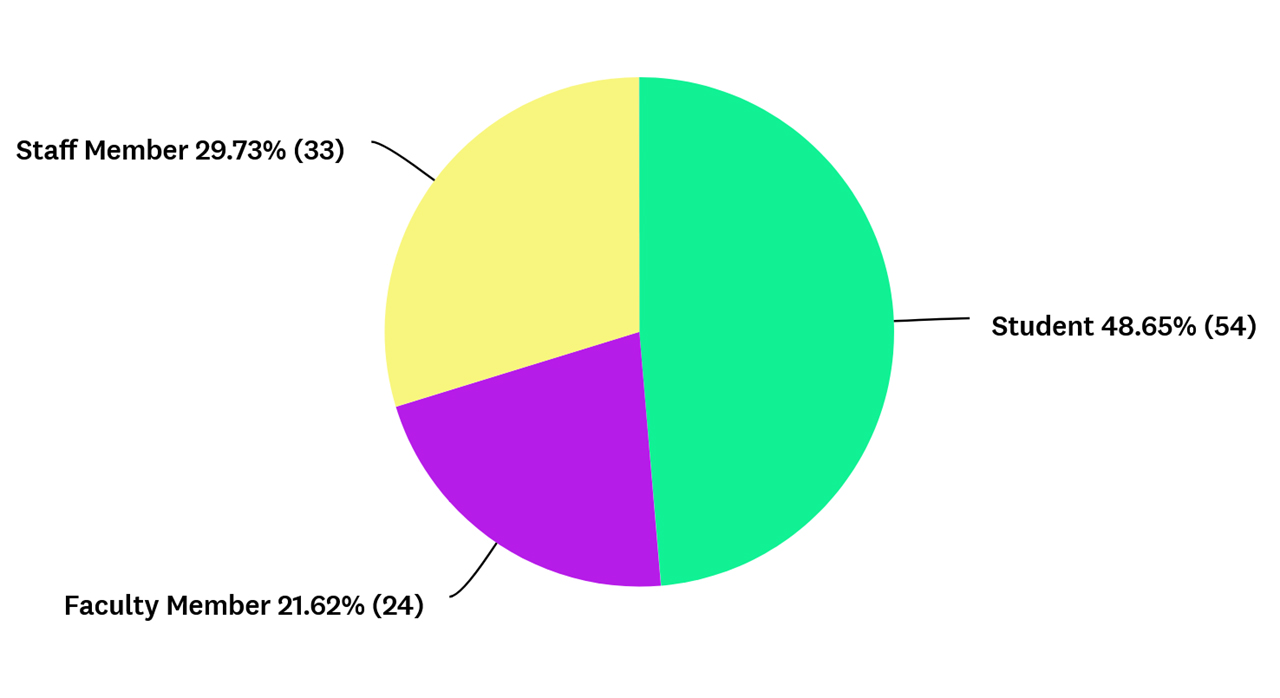
Who participated? We had 112 responses arrayed as follows:
Q1: President Trump, the Department of Justice and the Department of
Education have all issued statements asserting that programs and
practices using Diversity, Equity and Inclusion principles are illegal and
unconstitutional. What is your opinion?
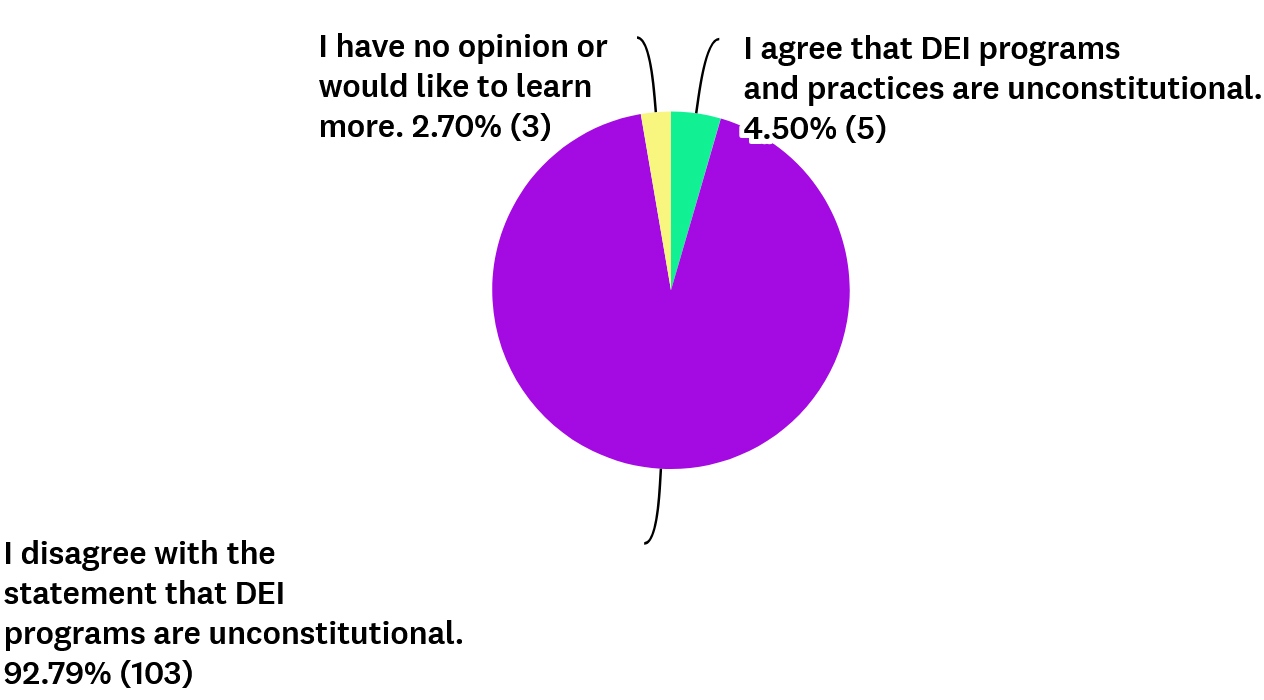
An overwhelming proportion of the Trinity community disagreed with the idea that diversity, equity and inclusion programs are somehow unconstitutional. Here are respondent comments elaborating on the answers:
Student: “Minority groups are recovering from decades, even centuries of long discrimination and abuse. DEI is a program that no matter what allows everyone to be considered, not by the color of their skin but for their skillsets. The Trump administration is backtracking all the progress that has been made to suppress the minorities because they’re scared of us. WE hold power that they see and some of us can’t. That is why minorities need to work together and keep showing up and showing out even when they try and take it away from us.”
Faculty: “The public pushback against DEI is politically motivated, but is nonetheless a challenge that demands a response. We need to be able to explain, in detail, why DEI is constitutional, legal, and a public policy good. It might be useful to invite a speaker to campus that could talk about these issues.”
Student: “The principles and clear understanding about Diversity Equity and Inclusion is not there. It is somewhat confusing and abstract and when people attempt to explain it, it’s not including me or others.”
Staff: “Only the Supreme Court can decide what is unconstitutional. While I am concerned that this Court would side with Trump, it is still the Court’s decision, not the executive branch’s.”
Student: “As we look into the republican party and realize there is no diversity, and inclusion within the party it is a while male dominated party that feel the need to have control over everything and anything they don’t know about. Getting rid of DEI not only hurt me as a woman but a woman of color as well because now for certain in the career path that I am choosing i will have to work twice as hard to get where I want to be and not deemed as not qualified because I’m a black woman.”
Staff: “DEI initiatives are generally grounded in longstanding constitutional and statutory authorities, particularly the Equal Protection Clause of the Fourteenth Amendment and federal civil-rights laws like Title VII permit and sometimes require affirmative action or other remedial efforts to correct discrimination, to ensure equal opportunity. This helps to account for historic inequities. Courts have upheld many DEI practices so long as they are narrowly tailored, have a legitimate government interest, and do not impose undue burdens or rigid quotas in a way that violates strict scrutiny. Recent court decisions rejecting bans on DEI programs have pointed out that prohibiting all DEI efforts would likely constitute viewpoint discrimination and be overly vague or infringing on free speech or due process rights.”
Student: “Diversity, Equity, and Inclusion (DEI) benefits students by exposing them to a campus community rich in diverse backgrounds, helping them develop compassion and cultural awareness. In my opinion, DEI enhances academic success by offering programs that supports first time generation and underrepresented students. These initiatives promotes a sense of inclusion and empowerment for students from all backgrounds, which encourages a greater participation in campus activities. DEI benefits in Universities brings forth a wide range of perspective from diverse faculty, staff, and students enhancing the academic and social environment on campus. By investing in DEI, institutions like Trinity demonstrates a commitment to empowerment, excellence, and preparing all scholars and graduates for success an interconnected or integrated world.”
Staff: “Maybe President Trump, the Department of Justice and the Department of Education needs to a course/class in Diversity, Equality and Inclusion.”
Student: “DEI programs help create more inclusive and diverse environments and promotes equal opportunities for everyone, especially Black and Hispanic students. I think this is very concerning and unfair to all of those affected, I hope that someday this will all be over and people are treated equally.”
Staff: “Equity for historically excluded populations requires additional investment. To reach equity under the constitution, congress should act to stop illegal defunding of DEI by the current administration.”
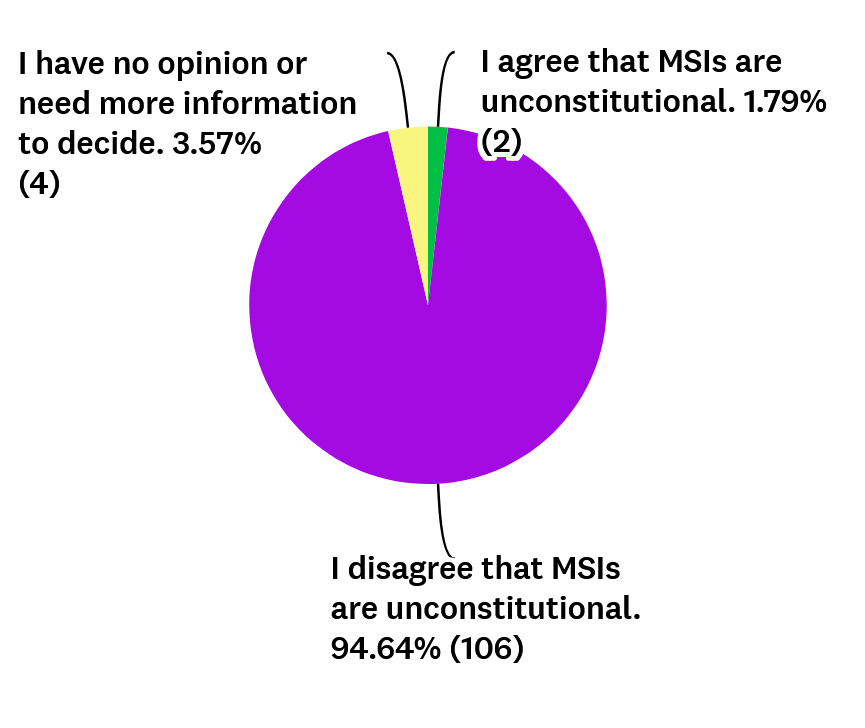
Q2: Last week, the U.S. Department of Education announced that it was immediatly terminating its grant programs for Minority Serving Institutions (MSIs) on the grounds that they unconstitutionally discriminate in favor of the racial groups served by those programs. (Trinity is both a Predominantly Black and Hispanic Serving Institution.) Do you agree or disagree with the Department of Education’s decision?
 Student: “I don’t agree with the idea that MSIs are unconstitutional. It is already extremely difficult for individuals of color to pursue further education in the U.S. MSIs serve as a bridge to lessen the educational gap. To say that these schools are unconstitutional is an attempt by political officials (who are majority white and able to pay for college) to keep people of color from furthering their education.”
Staff: “The MSI grants go to the institutions, not individuals, and therefore this grant money is used on things that benefit all students at a University, not just those of a particular race or ethnicity.”
Student: “What is unconstitutional is taking away people’s rights to better themselves.”
Staff: “Predominently Black or Hispanic Serving” are not terms that give preference ONLY to one race or ethnicity. As noted in my response to question #1, only the Supreme Court can decide what is unconstitutional. While I am concerned that this Court would side with Trump, it is still the Court’s decision, not the executive branch’s. From a spending standpoint, Congress needs to shed it’s cowardly lion persona and regain the courage to take back control of the purse they alone control.”
Student: “I completely disagree with the termination of grants that serve MSI like our campus. I moved to DC thinking I would have more opportunities, but doors seem to be closing for Black and Hispanic students who want to pursue a higher education. It has been very discouraging and hard for people who look like me.”
Staff: “If MSIs are “unconstitutional”, why is the Department diverting much of this funding to HBCUs? The Department is using the funding as a political tool rather than a support to students who most need it.”
Student: “In my view, the U.S. Department of Education’s decision to terminate grant programs on grounds of alleged unconstitutional discrimination is both disappointing and hurtful. These grants plays an important role in strengthening education departments and support special populations, such as those dserved under the Individuals with Disabilities Education Act (IDEA). They also provide essential funding for low-income families and communities, helping students to seek their higher education. Grants awarded to institutions are normally based on financial need, programs like the Federal Pell Grant are important for students like me…those enrolled in their first undergraduate program and faces financial challenges at times. By eliminating these resources undermines efforts to create equitable access to education and limits possibilities for those who need support the most.”
Staff: “The Department of Education’s decision to end MSI grant programs is a cop-out because these institutions do not discriminate by race; they serve all students while addressing historic underfunding and systemic inequities. MSI designations are based on mission and demographics, not exclusion, and courts have long upheld the government’s compelling interest in remedying barriers to equal education. By mischaracterizing MSIs as unconstitutional, the Department sidesteps its duty to promote equity and undermines the very communities Congress intended to support.”
Thanks to all for participating in this survey!
I had a few things to say about the termination of the MSI funding in a recent CNN interview… watch it here: McGuire Interview on CNN regarding MSI funding
More on this and related topics at our upcoming Campus Conversations on September 24 at 4 pm on zoom — join us then!
