
A Government Without Newspapers
“The basis of our governments being the opinion of the people, the very first object should be to keep that right; and were it left to me to decide whether we should have a government without newspapers or newspapers without a government, I should not hesitate a moment to prefer the latter. But I should mean that every man should receive those papers & be capable of reading them.”
– Thomas Jefferson, Letter to Edward Carrington, January 16, 1787
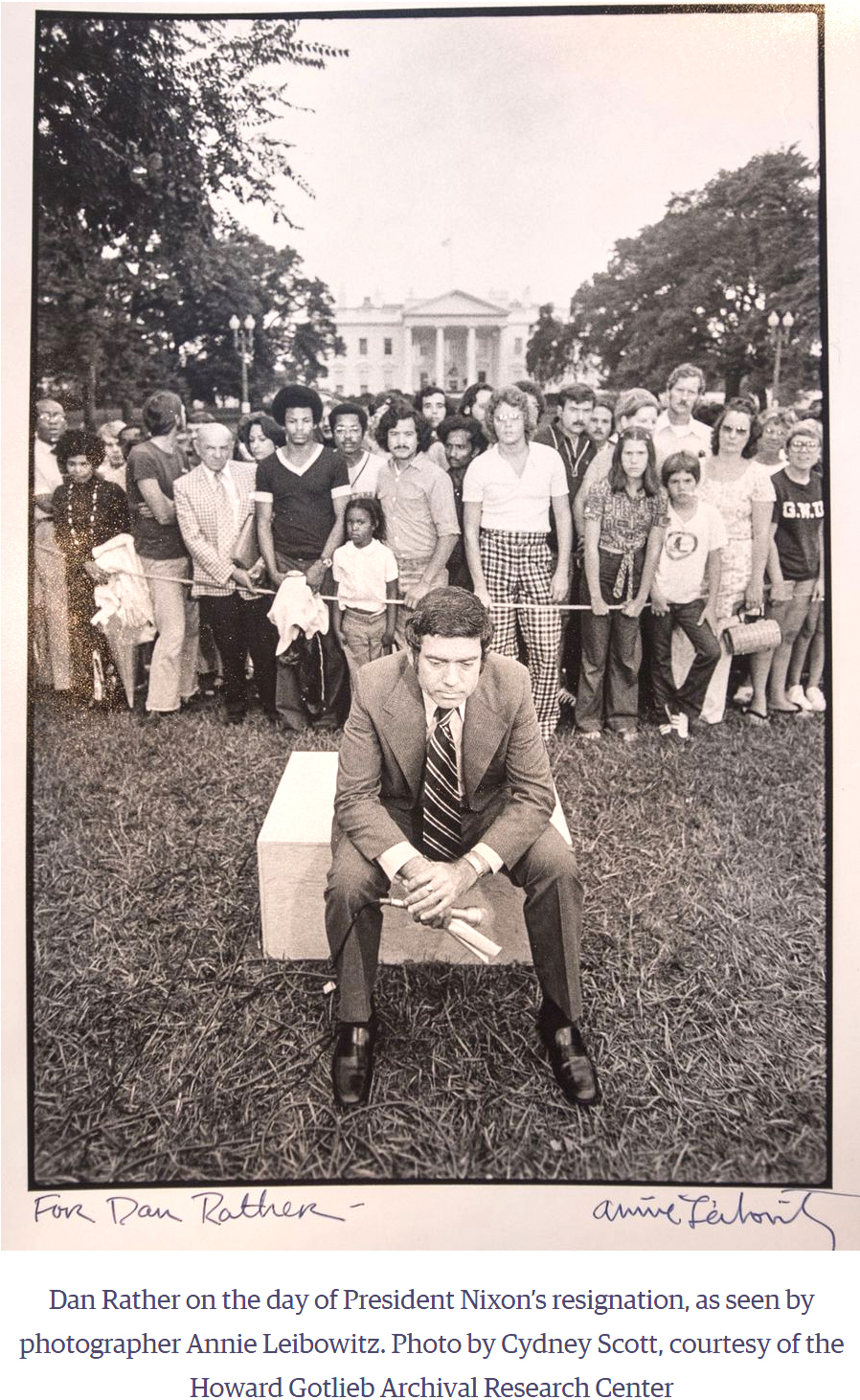
I am old enough to remember standing in Lafayette Park across from the White House on August 9, 1974, watching then-CBS News White House reporter Dan Rather standing on a wooden crate while broadcasting the extraordinary news: President Richard Nixon had resigned from the presidency and was leaving the White House immediately! Rather announced that Nixon would leave from the south lawn of the White House, so with thousands of others I rushed down 15th Street to get to the Ellipse — it was easy to get around the White House block in those days — and as Nixon’s helicopter rose from the lawn a strange silence came over the crowd and then thousands of arms raised up waving goodbye to the person who, at that time, was the most hated president in American history.
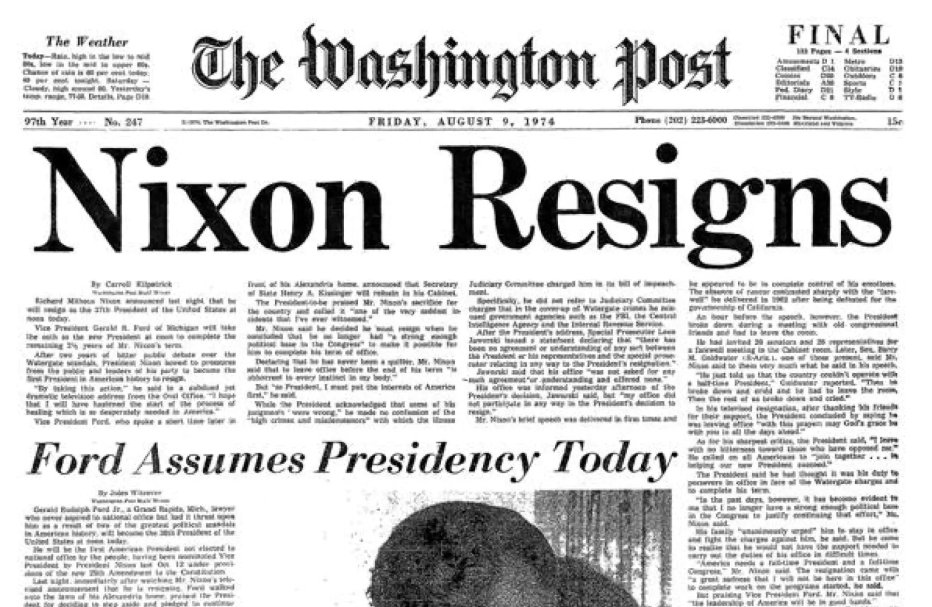
 A confluence of many factors forced the resignation of Richard Nixon: a bumbling “third rate burglary” of the Democratic National Committee office in the Watergate apartment complex by agents of Nixon’s campaign for re-election to a second term; a staunch chairman of the Senate Watergate Committee, the formidable Senator Sam Ervin; courageous testimony of Nixon aides revealing a secret audio taping system in the Oval Office; a Supreme Court that knew its real role in the balance of powers rejecting Nixon’s claim to “executive privilege” for the tapes (U.S. v. Nixon).
But none of these factors might have brought down the president without one central driving force: the relentless investigatory work of reporters at the Washington Post — Bob Woodward and Carl Bernstein — and the courageous backing they received from their Editor-in-Chief Ben Bradlee and Publisher Katharine Graham.
The recent shocking evisceration of the newsroom at the Washington Post — nearly half of the reporters were fired, the sports and books sections closed, international reporting gutted, Metro gone, and so much more — evoked memories of the years when that legendary newspaper and others proved the truth of Jefferson’s statement about the critical role of newspapers in maintaining a strong, functional democracy. Democracy thrives when information and knowledge are freely available to the people, and at their best, newspapers and other media outlets hold government accountable to the people by reporting facts about official actions.
Without a strong and courageous Washington Post, Nixon might have remained in office and the course of history in that era would have been very different.
Without the courageous stance of the New York Times in publishing the Pentagon Papers, the American people never would have known about the decades of official lies and deception that fueled the Vietnam War and America’s failed strategy in southeast Asia.
Without the tenacity of the Boston Globe investigative team uncovering decades of child abuse in the Catholic Church, the world might not have learned about the horrific scandal involving thousands of priests and the cover-ups by the hierarchy.
From the fearless investigative work of Ida Tarbell at the turn of the 20th Century exposing the abuses of Standard Oil and John D. Rockefeller, to the exposure of the NSA’s surveillance program, to the “60 Minutes” news magazine report on Big Tobacco’s manipulation of smokers’ cravings, to the reports on Harvey Weinstein that led to the #MeToo movement on sexual assault — and so much more — newspapers and media broadly have long played a vital role in keeping the American public informed while lifting up and rooting out corruption in government and major corporations.
A century or more of courageous journalism now appears at-risk. The decision of the Publisher of the Washington Post Will Lewis (now former publisher) — a decision presumably blessed if not ordered by Post Owner (and Amazon billionaire) Jeff Bezos — threatens to accelerate a decades-long decline in newspapers. One study reports that more than 3,500 newspapers have shuttered since 2005, eliminating several hundred thousand jobs.
Corporate executives like Bezos and Lewis claim that newspapers are dinosaurs, that new digital media platforms are the reasons for the deaths of traditional ink-and-paper broadsheets. That is too facile an excuse. The best newspapers long ago adapted to the digital age; blaming technology for a mercenary corporate decision devoid of journalistic values is a cop-out. Moreover, their claim that the newspaper needs to do a better job figuring out what people want to read is ridiculous. Just as students don’t know what they don’t know, and need to study the broad range of disciplines in core curricula to become at least semi-literate, so, too, newspaper readers don’t go looking for affirmation but rather discovery. We want to learn more about what we don’t know, read stories about people who are not like us, consider ideas that never occurred to us or that might infuriate us but at least challenge us to think and reconsider our own ideas.
The real risk of this era in free press and media more generally lies in the phenomenon of voracious corporate interests — especially technology titans — gobbling up news media outlets. Newspapers, broadcast networks, social media such as X or Facebook — all have fallen victim to owners whose financial and political interests are at odds with maintaining a free and robust independent press. Watching what is happening to the storied “60 Minutes” investigative program on CBS News, for example, is simply painful as the new corporate ownership stifles coverage that criticizes the current administration. The Washington Post lost tens of thousands of subscribers with its rightward trends over the past year. Far from sustaining nonpartisan and independent judgment among journalists, the corporate ownership interests curry favor with politicians who sit in judgment on their business relationships and governmental contracts.
Beyond the loss of jobs and information about our local communities as media outlets shrink, the even more serious problem with the demise of newspapers and independent media — and, in particular, the debilitation of the Washington Post — is the challenge inherent in Jefferson’s message of 1787. Government needs a vigorous and independent press to keep it honest, to hold it accountable, to rein in power grabs, to challenge rising authoritarianism.
This nation is living through one of the most dangerous moments in its history, an era when we could lose the freedoms and rights that so many people fought to achieve and sustain across the 250 years of our history. Without a strong and even aggressive free press reporting on the issues of this era, the authoritarians in government will push even harder on their agenda to weaken our democracy and secure their own power for years to come.
Jefferson’s last phrase in the quote at the top of this blog is particularly important right now: “I should mean that every man should receive those papers & be capable of reading them.”
A well-educated population, consistently and routinely informed by the free press, is essential for the health and vitality of any democracy. At the same time as the press is undergoing a debilitating transformation into some kind of mouthpiece of corporate owners, education is also under assault by a political administration that seeks to dictate curricula and limit academic freedom. The combination of weak press and stifled universities will spell disaster for this nation if we don’t wake up soon to reclaim the voices and venues that nurture democracy and freedom.
A government without newspapers is a tyranny. Read your history to learn more about what happened when the press and universities were suppressed in places where tyranny arose; start with 1930’s Germany or the rise of the Soviet Union.
And watch these movies:
Becoming Katharine Graham (2025)
The Post (2018)
Frost/Nixon (2008)
All the President’s Men (1976)
1 Comment

Well said!